Posted on: 28-Oct-25
If you’ve been pouring time into creating great content but your website still isn’t showing up on Google’s first page, it might be time to look inward.
Literally.
Your secret weapon isn’t just backlinks or social shares — it’s on-page SEO. This is where you fine-tune everything on your own website to make it easier for both users and search engines to understand, trust, and love your content.
In this post, we’ll break down the key on-page SEO elements that can make or break your rankings — and show you how to optimize each one like a pro.
On-page SEO (or on-site SEO) refers to the process of optimizing the content and HTML source code of individual web pages.
It’s about making sure your pages are both relevant and readable — for humans and search engines alike.
Think of it this way:
Off-page SEO helps people discover your site.
On-page SEO gets them to stay and trust it.
Search engines like Google use hundreds of ranking factors, but on-page signals remain some of the most powerful.
When done right, on-page SEO helps Google answer questions like:
What is this page about?
Who is it useful for?
Is it high-quality and trustworthy?
By optimizing your pages properly, you help Google connect your content with the right audience — and that means better rankings and more traffic.
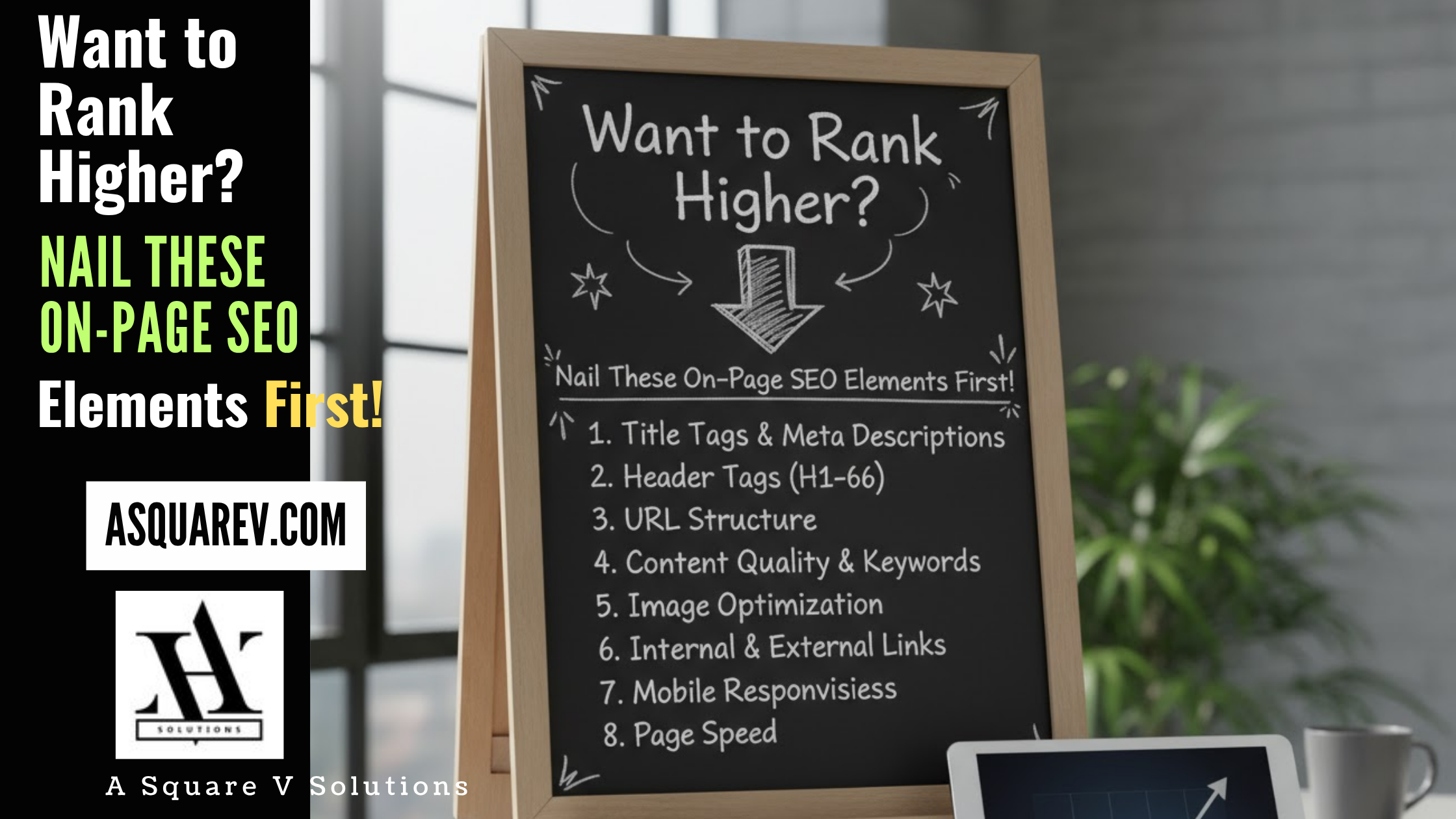
Your title tag is the headline that appears in search results — it’s the first thing people see.
Tips:
Keep it under 60 characters
Place your main keyword near the beginning
Make it click-worthy and relevant
Example:
“Want to Rank Higher? Nail These On-Page SEO Elements First!”
“SEO Tips and Tricks”
While not a direct ranking factor, meta descriptions influence your click-through rate (CTR).
Tips:
Write 150–160 characters
Include your main keyword
Focus on benefits or action
Example:
“Boost your website’s visibility with these proven on-page SEO elements. Learn how to optimize titles, content, and more for better rankings.”
Headers structure your content for readability.
Tips:
Use only one H1 (your main topic)
Break sections with H2S and H3S
Use keywords naturally
Pro Tip: Search engines “scan” headers to understand content hierarchy — make them meaningful, not just decorative.
Clean, descriptive URLs help both users and search engines.
Example:
✅ www.example.com/on-page-seo-tips
❌ www.example.com/page?id=4567
Keep URLs short, relevant, and keyword-rich.
Keywords are your connection to what users search for — but overusing them can backfire.
Tips:
Add your main keyword in:
Title tag
H1 heading
First 100 words of content
A few times throughout the text
Focus on readability — not repetition
Internal links guide visitors (and Google) through your site.
Tips:
Link to related articles or service pages
Use descriptive anchor text (e.g., “check our SEO checklist”)
Avoid excessive linking — keep it natural
Bonus: Internal links spread “link equity” and help search engines index your pages more effectively.
Images are great for engagement, but they can also slow your site down.
Tips:
Use descriptive file names (e.g., on-page-seo-guide.jpg)
Add alt text with relevant keywords
Compress images without losing quality
Why it matters: Alt text helps search engines understand images and improves accessibility.
Your content is the foundation of everything.
Tips for top-performing content:
Answer user intent directly
Keep paragraphs short and scannable
Add visuals, examples, and statistics
Update content regularly
Remember, Google’s goal is to deliver the best answers — make sure yours is one of them.
Nobody likes a slow website — and neither does Google.
Tips:
Compress large files
Use caching and a CDN
Minimize unnecessary code and scripts
Fast-loading pages keep users happy and reduce bounce rates.
With mobile-first indexing, your site must look great on every device.
Checklist:
Responsive design
Easy navigation
Readable text and clickable buttons
Use Google’s Mobile-Friendly Test to check how your site performs.
Once you’ve nailed the basics, consider these extras:
Schema Markup → adds rich snippets in search results
Canonical Tags → prevent duplicate content issues
SSL Certificate (HTTPS) → builds trust and improves ranking signals
Ranking higher on Google isn’t about luck — it’s about structure, strategy, and smart optimization.
When you master on-page SEO, you give your website the foundation it needs to thrive.
So before you chase backlinks or paid ads, take the time to perfect what’s already yours.
Start with your titles, headers, and content, and soon enough, you’ll see your rankings climb.
If you’re looking for professional digital marketing services in Calgary, Alberta, A Square V Solutions has you covered.
We specialize in SEO, on-page optimization, web design, and performance marketing — helping local businesses grow online with measurable results.
Special Offer: Get 1 month of free SEO services, including on-page SEO and technical optimization, when you sign up with A Square V Solutions today!
Start ranking higher, attracting more leads, and building your brand with expert digital marketing tailored to your business needs.
Contact A Square V Solutions and take the first step toward dominating your local search results.
#OnPageSEO #SEOtips #DigitalMarketing #CalgaryBusiness #SEOServicesinCanada #SearchEngineOptimization #WebMarketing #OnlineVisibility #SEOServices #DigitalMarketingCalgary #SEOExpert ##SEOServicesinUSA #WebsiteOptimization #GrowYourBusiness #LocalSEO #ASquareVSolutions